HPE ProLiant DL365 Gen11 Server Specifications and Compatible Hardware
A technical reference for AMD EPYC processors, memory, storage chassis, networking, expansion and configuration requirements
The HPE ProLiant DL365 Gen11 is a 1U, two-socket rack server built around 4th Generation AMD EPYC processors and DDR5 registered memory. Its factory configurations include an 8SFF chassis, an EDSFF NVMe chassis and a GPU-oriented chassis. This guide summarizes supported hardware, the configuration rules that govern upgrades, and links to detailed component reference pages.
The QuickSpecs identifies compute-intensive workloads such as VDI, electronic design automation (EDA) and computer-aided design (CAD). This reference follows the attached HPE QuickSpecs, including its model-specific restrictions and discrepancies.
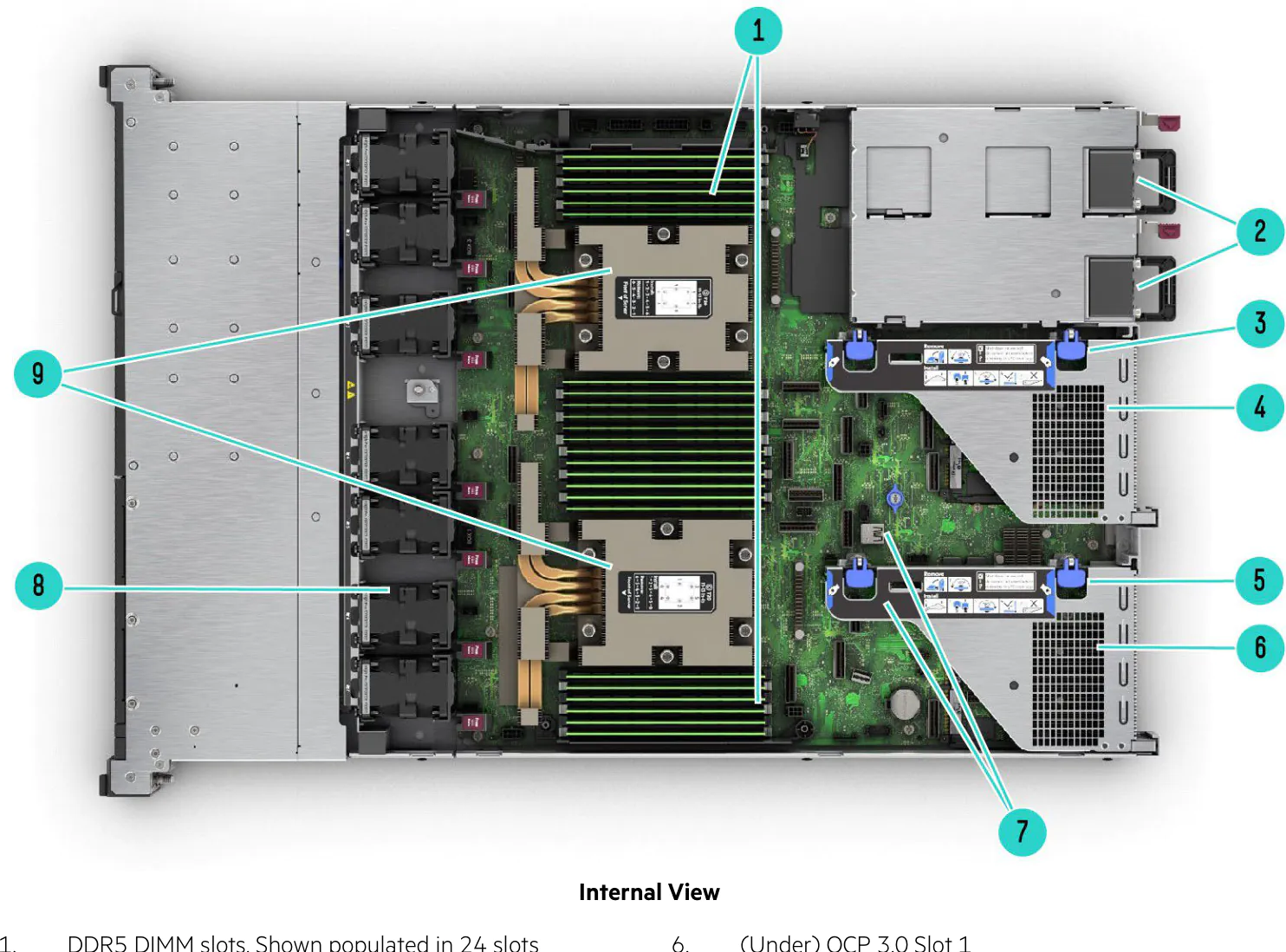
1U server with up to two AMD EPYC 9004-series processors and 24 DDR5 RDIMM slots.
The standard 8SFF CTO chassis requires a backplane selection; EDSFF and GPU CTO chassis have separate restrictions.
CPU wattage, drive formats and adapter selections determine mandatory cooling and expansion options.
DL365 Gen11 specifications at a glance
The values below describe the platform; some maximums depend on the exact chassis and processor/cooling configuration.
Platform technical specifications
| Specification | QuickSpecs details |
| Server model | HPE ProLiant DL365 Gen11 |
| Form factor | 1U rackmount; 4.29 x 44.89 x 64.94 cm (H x W x D) |
| Processor family | 4th Generation AMD EPYC 9004-series processors; Genoa, Bergamo and Genoa-X options listed |
| Maximum processors | 2 sockets; matched processor models required for 2P builds |
| Listed processor core counts | 16 to 128 cores per processor in option-kit list; opening overview instead states up to 96 cores |
| Memory | HPE DDR5-4800 registered Smart Memory (RDIMM), including 3DS RDIMM options |
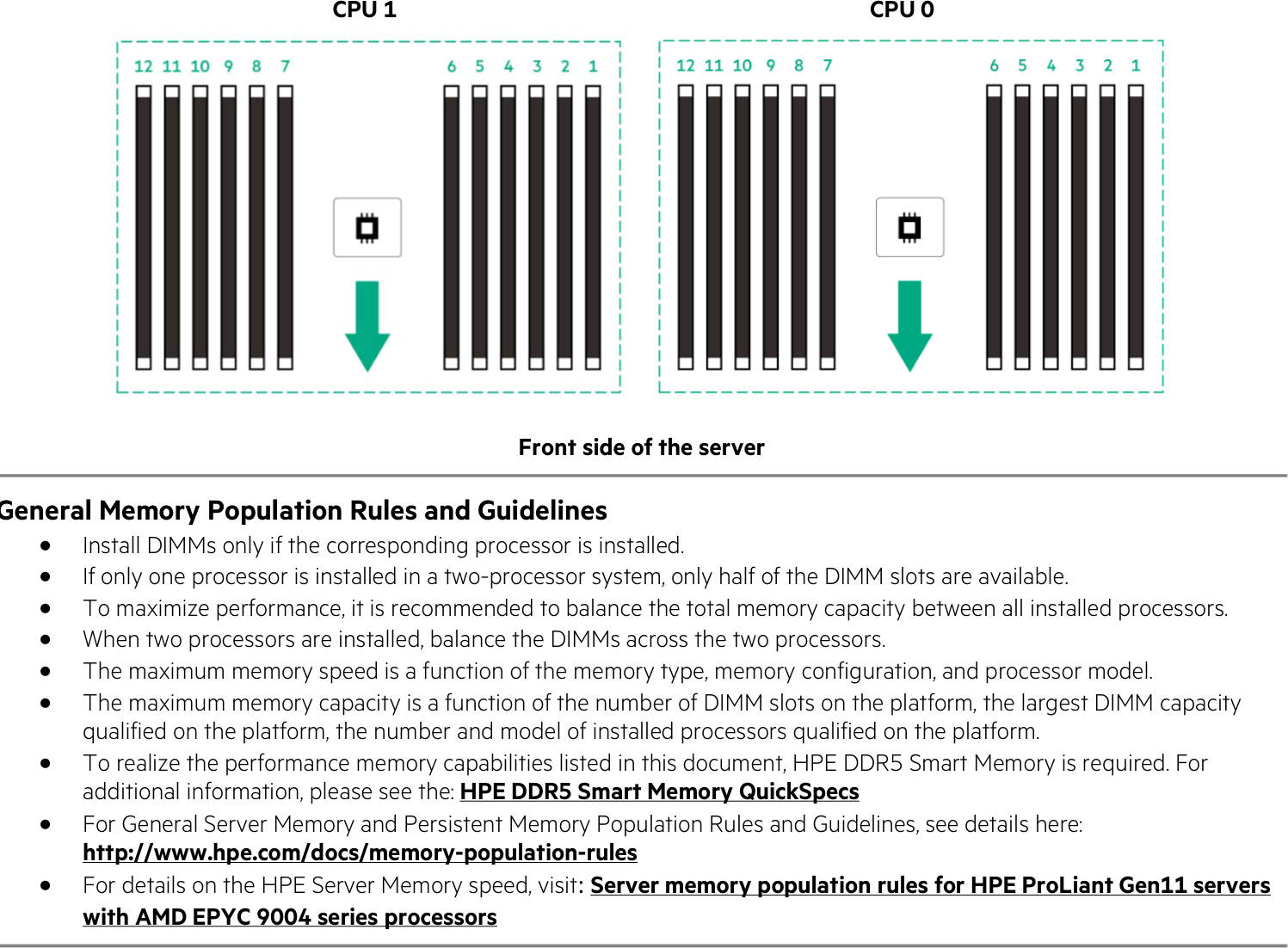
| DIMM slots | 24 total, 12 per CPU, 1 DIMM per channel |
| Maximum memory | 6TB using 24 x 256GB RDIMMs with two CPUs, subject to memory/thermal restrictions |
| Chassis options | 8SFF CTO; 20 EDSFF CTO; GPU CTO (storage/backplane specifications vary by section) |
| Storage interfaces | SAS, SATA and NVMe U.3 for supported SFF backplanes; NVMe EDSFF for EDSFF builds |
| Storage controllers | HPE MR Gen11, SR Gen11 and E208e-p offerings; controller support depends on backplanes |
| Boot device | Optional HPE NS204i-u Gen11 NVMe Hot Plug Boot Optimized Storage Device with integrated mirrored NVMe SSDs |
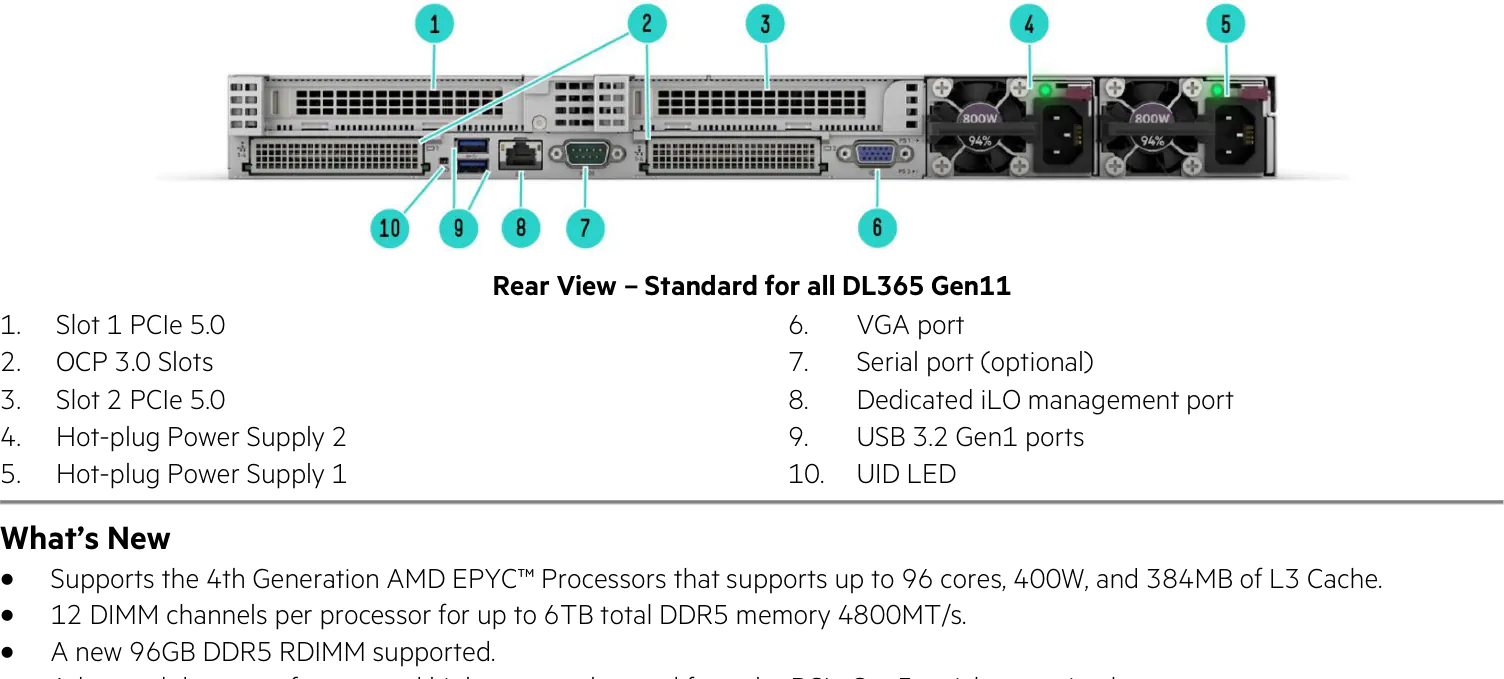
| Expansion | PCIe Gen5 x16 primary slot; optional secondary riser and GPU-specific front risers; OCP 3.0 network slots |
| Network ports | No standard data network ports on CTO base; OCP/PCIe adapter selected separately; dedicated 1Gb iLO port |
| Power supplies | 800W, 1000W, 1600W and 1800W-2200W Flex Slot AC selections plus 1600W -48VDC option |
| Fans / cooling | Up to 7 fans; standard/performance fan kits, heatsinks and DLC depending on build |
| Management | HPE iLO 6, UEFI, Intelligent Provisioning; optional management software/licenses |
| Approximate SFF weight | 12.70 kg minimum; 18.39 kg maximum (documented configurations) |
| Source | HPE ProLiant DL365 Gen11 QuickSpecs, printed pages 1-7, 18-24 and 38 |
Server chassis and front storage configurations
The three CTO chassis families are not interchangeable product descriptions. The 8SFF CTO starts with an 8SFF cage but does not include its backplane. The EDSFF and GPU CTO configurations have separate mandatory processor, thermal and backplane choices. The GPU CTO entry on page 18 lists a 20 EDSFF included cage, while the GPU-specific backplane options on page 22 require a 4SFF NVMe or 8EDSFF front backplane; this discrepancy needs verification for exact orders.
CTO chassis and storage comparison
| CTO server / part number | Front storage in QuickSpecs | Expansion / limitations |
| 8SFF CTO / P53933-B21 | 8SFF cage included; backplane selected separately | May add optional 2SFF U.3 bay for maximum 10 front SFF drives; optional optical bay; no rear drive cage in CTO table |
| EDSFF CTO / P53934-B21 | 20 EDSFF drive bay listed | Requires two processors, performance fans and performance heatsink or DLC; high-TDP CPU conditions can limit usable EDSFF slots |
| GPU CTO / P53935-B21 | Page 18 lists 20 EDSFF; page 22 requires selection of 4SFF NVMe or 8EDSFF GPU backplane | Dedicated front GPU riser; GPU-related backplanes direct attach to motherboard and disallow internal controllers; verify conflicting chassis descriptions |
8SFF front-bay layouts and backplanes
The optional media position can house a 2SFF U.3 cage for a maximum of 10 front SFF drives or an optical drive. HPE lists x1 and x4 8SFF U.3 backplanes, a 2SFF x4 backplane, and an NVMe trigger kit. The required storage cables and controller/direct-attach path depend on the chosen backplane. A maximum drive count does not mean every CPU/cooling combination supports that maximum.
Selected front backplane options
| Part number | Backplane / kit | Primary restriction |
| P55020-B21 | HPE ProLiant DL365 Gen11 8SFF Tri-Mode U.3 x1 BC FIO Backplane Kit | Requires supported controller and x1 cable path |
| P55021-B21 | HPE ProLiant DL365 Gen11 8SFF Tri-Mode U.3 x4 BC FIO Backplane Kit | Mixed drive types depend on tri-mode controller selection |
| P55025-B21 | HPE ProLiant DL365 Gen11 2SFF Tri-Mode U.3 x4 BC Balanced Backplane Kit | Optional 2SFF expansion; controller and cable requirements apply |
| P63212-B21 | HPE ProLiant DL365 Gen11 4SFF Tri-Mode U.3 x4 BC FIO Backplane Kit | GPU CTO only; NVMe drives only; motherboard direct attach |
| P63215-B21 | HPE ProLiant DL365 Gen11 8EDSFF NVMe FIO Backplane Kit | GPU CTO only; motherboard direct attach |
| P58763-B21 | HPE ProLiant DL365 Gen11 NVMe FIO Trigger Kit | Supports 10 SFF NVMe direct attach; drives selected separately |
Compatible hardware and upgrade category directory
Use these category guides for complete manufacturer part-number tables, model-specific requirements and related hardware. Links below are explicit placeholders for iRecommend publication.
Processors and DDR5 memory
The two-socket platform lists 4th Generation AMD EPYC processor kits including standard, F-series, Bergamo and X-series options. A second CPU must match the first processor model, and processor kits do not automatically include heatsinks and fans. While the front overview mentions 96 cores, the option-kit list includes 112-core EPYC 9734 and 128-core EPYC 9754 parts. Check the selected CPU kit and thermal configuration rather than relying on the introductory core count.
The platform has 12 memory channels per processor and 24 DIMM sockets only when two processors are installed. Registered DDR5-4800 DIMMs include 16GB through 256GB choices. HPE prohibits mixing x4 and x8 DIMMs and mixing 3DS with non-3DS modules. The 128GB/256GB options require performance heatsinks and seven performance fans; 256GB memory may have additional constraints.
Storage technologies and capacity planning
HPE lists SAS and SATA hard drives, SAS and SATA SSDs, NVMe Gen4 U.3 SFF SSDs, and NVMe Gen5 E3.S EDSFF SSDs. The standard-feature maximum-storage examples are based on 8+2 SFF configurations, not universal capacity guarantees. In addition to media type and capacity, the backplane, controller, cables, CPU wattage and cooling configuration govern usable drive combinations.
Published SFF maximum storage examples
| Media class | Published maximum | Example configuration |
| SFF SAS HDD | 24TB | 10 x 2.4TB |
| SFF SATA HDD | 20TB | 10 x 2.0TB |
| SFF SAS SSD | 76.8TB | 10 x 7.68TB |
| SFF SATA SSD | 76.8TB | 10 x 7.68TB |
| SFF NVMe U.3 SSD | 153.6TB | 10 x 15.36TB |
The source does not present an equivalent consolidated EDSFF capacity table. On the 8SFF CTO without direct liquid cooling, processors at or above 320W limit the configuration to eight drives. On the EDSFF CTO, the same CPU wattage threshold limits EDSFF drive count to 12, unless a DLC module is selected. For GPU CTO, the 4SFF or 8EDSFF GPU backplanes specified on page 22 are motherboard-attached and do not allow internal controllers.
The optional NS204i-u provides externally accessible hot-plug mirrored boot media with two embedded 480GB NVMe SSDs, and requires the documented low-profile secondary riser arrangement.
Networking, OCP and PCIe expansion
The chassis does not include a standard Ethernet data port in its CTO baseline. It offers network adapter selection through PCIe cards and OCP 3.0, while the dedicated 1Gb HPE iLO management port remains separate. The QuickSpecs lists Ethernet, Fibre Channel and HDR/NDR InfiniBand choices; adapter thermal rules and OCP upgrade cabling must be checked per configuration.
PCIe Gen5 x16 expansion is available through a standard primary riser and an optional second riser. Secondary riser forms cannot occupy the same physical position simultaneously. GPU CTO adds front GPU riser positions and GPU-specific bandwidth/space limitations.
Expansion and networking constraints
| Component | Key qualification |
| Primary PCIe riser | PCIe Gen5 x16, processor 1 in QuickSpecs expansion table |
| Secondary PCIe riser | PCIe Gen5 x16, processor 2; choose full-height half-length or low-profile position |
| GPU risers | Full-height full-length x16 front slots associated with processors 1 and 2 |
| OCP 3.0 | Cabling differs between 1P and 2P; one-processor OCP1 kit restricts maximum OCP card quantity to one |
| InfiniBand | Performance fan requirements and 25C ambient restrictions for certain AOC/DAC adapter configurations |
| NS204i-u | Low-profile secondary riser P55029-B21 requirement |
Power, fans and thermal configurations
Flex Slot power-supply selections include 800W Platinum, 1000W Titanium, 1600W Platinum, 1800W-2200W Titanium, and 1600W -48VDC. Power supply SKUs cannot be mixed in a two-PSU configuration. The 1800W-2200W selection requires 200-240VAC high-line power, while the -48VDC PSU requires its documented lug or cable accessory. HPE recommends sizing with Power Advisor.
Cooling selections are configuration-dependent. The QuickSpecs requires performance cooling for processor, NVMe, EDSFF, GPU and high-density configurations. Performance heatsinks or DLC may be needed for high-power CPUs, and DLC includes additional module and tube-kit requirements. Detailed thresholds are described in the processor and cooling guides.
Representative cooling conditions
| Configuration | QuickSpecs requirement / limitation |
| Low-TDP 8SFF builds | Standard fans/heatsinks permitted only under the stated CPU wattage and drive rules |
| Processor above 240W | Performance heatsink and performance fan selection required in configuration section; DLC-specific rules may apply |
| 128GB or 256GB RDIMMs | Performance heatsink and seven performance fans required |
| EDSFF CTO | Two CPUs plus performance fans and performance heatsink or DLC |
| GPU CTO | Performance fan/cooling configuration and GPU-specific power cable required |
| NVMe or SAS4 and 10SFF | Performance fan kits required by platform-feature rules |
Important configuration checks before ordering
These are source-specific restrictions, not general assumptions about every HPE Gen11 server. Factory CTO eligibility and field upgrades can differ, and HPE recommends verifying final combinations in an approved configurator.
What processors can the HPE ProLiant DL365 Gen11 use?
The attached QuickSpecs lists 4th Generation AMD EPYC 9004-series processor option kits. The CPU list includes models with 16 through 128 cores; dual-processor systems must use matching processor models.
How much memory does the DL365 Gen11 support?
The document specifies up to 6TB using 24 x 256GB DDR5 registered DIMMs and two CPUs. Memory population and thermal rules restrict specific combinations.
Can the 8SFF chassis be expanded to ten drives?
The 8SFF CTO can use an optional 2SFF U.3 cage for up to ten front SFF bays, subject to cabling, controller, processor and cooling limits.
Does the DL365 Gen11 support EDSFF Gen5 SSDs?
Yes. The QuickSpecs lists NVMe Gen5 E3.S EDSFF SSDs and an EDSFF CTO chassis. Drive count and thermal requirements depend on configuration.
Are network ports included by default?
The CTO platform provides a dedicated 1Gb iLO management port, but network data adapters are selected separately as OCP or PCIe cards.
Can a GPU be installed in every DL365 Gen11 chassis?
The listed NVIDIA A16 accelerator is supported only with the GPU CTO configuration and requires an associated GPU power cable. The GPU backplane and cooling requirements also apply.
Can different Flex Slot power-supply wattages be mixed?
No. The QuickSpecs prohibits mixing different power-supply SKUs in the same server.